What is Crew Management?
The simplest explanation is converting an airline flight schedule into legal periods of work which Crew will undertake, ensuring every flight can operate as scheduled with the required number of crew.
This explanation raises the following points:
| Question | Function |
|---|---|
| How many Crew should be employed? | Manpower Planning |
| Who will ensure crew are always proficient to undertake periods of work? | Training Planning |
| Who will convert the schedule into periods of work? | Pairing Planning |
| Who will publish the periods of work allocated to crew? | Roster Planning |
| Who will manage and track the movements of crew? | Crew Control |
From this simple concept of a definition, there are at least five areas of interest involved, described below in further detail. Crew Management could be thought of as a department and each area as a team. The size and complexity of an airline will drive the size of an individual section of the department.
A Low-Cost Carrier may only use one employee to manage all sections, whereas a Legacy Airline may use 50+ employees to manage each section. As the airline grows or feels the need to have clear accountabilities for each area of crew management, new teams as mentioned above are introduced. For example, many airlines have created analytics teams in one or more of these areas.
With the advent of Low-Cost Carriers, new business models emerged that fundamentally changed the way airlines operate. Increased pressure on cost reduction and optimized spending is now firmly on the agenda. Yet, a fine line exists between controlling costs and delivering quality service that drives customer satisfaction. Crew Management sits between both.
Airlines of all sizes stand to benefit from airline operations and crew planning optimization. For smaller airlines, where immediate optimization return on investment (ROI) may be less clear, the advantage centers around the ability to quickly assess and respond to the impact of changes to operational plans. This is especially useful when the airline is in growth acceleration mode and increases its fleet and network. Here, optimizers help the airline evaluate the impact on staffing, efficiency, and operating costs of new and changing schedules. An airline in growth mode can use optimization to bridge staff shortages by using limited available resources as efficiently as possible.
Stakeholders
- Network Planning’s objective is to maximize profitability across an airline’s entire schedule.
- Flight Operations and Cabin Crew Management manage the crew members’ performance.
- Human Resources or Labor Relations manage the crew work rules or contracts.
- Operations Control Center manage the crew schedule operation, including disruptions.
This can sometimes cause conflict of interest. Stakeholder meetings or integrated planning can be useful for sharing information, an ideal forum in which to communicate the importance of the process flow plan. Effective Crew Management also means stakeholder management, both internal stakeholders (pairing vs. rostering vs. training) as well as external ones (crew/union vs. management vs. fleet vs. ground operations).
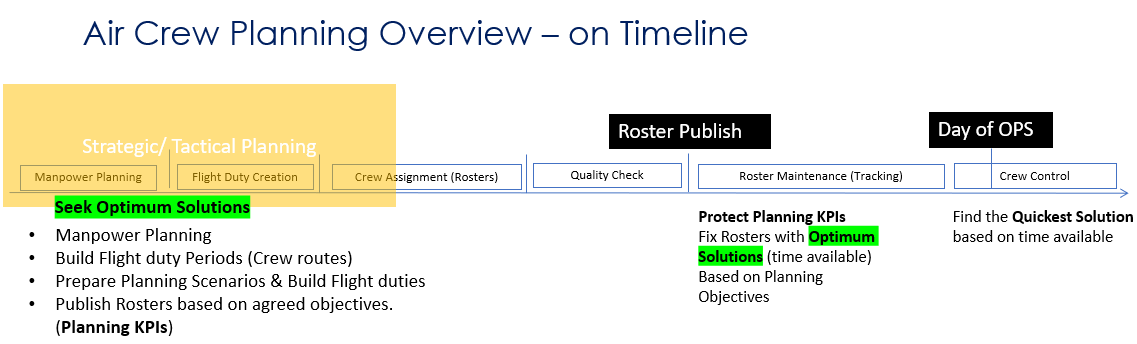
Roster Periods
Crew schedule construction is usually completed in roster periods. The duration of a roster period can vary between airlines, however, the most common is based on a calendar month.
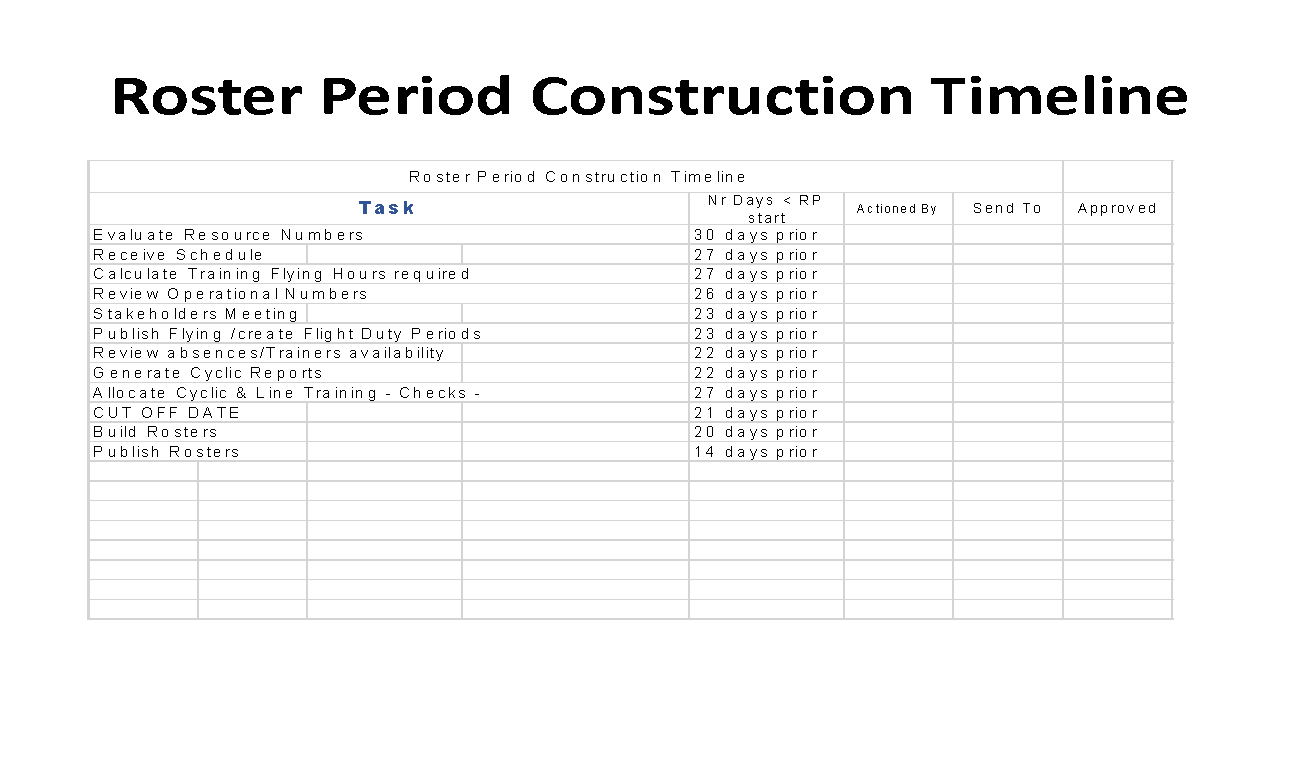
Planning for a future roster period means identifying the tasks which need to be completed and deadlines set to produce a roster by a specified date.
A crew planning timetable is formulated in which all tasks are identified, timelines calculated and published to all areas involved in the formulation of a crew roster. Below is a sample roster period timeline.
Basic Processes of Crew Management
Every airline provides either a customer transportation service, a freight delivery service, or a combination of both. Crew Management is the process to ensure the desired transportation service is staffed.
The primary role of Crew Management is to:
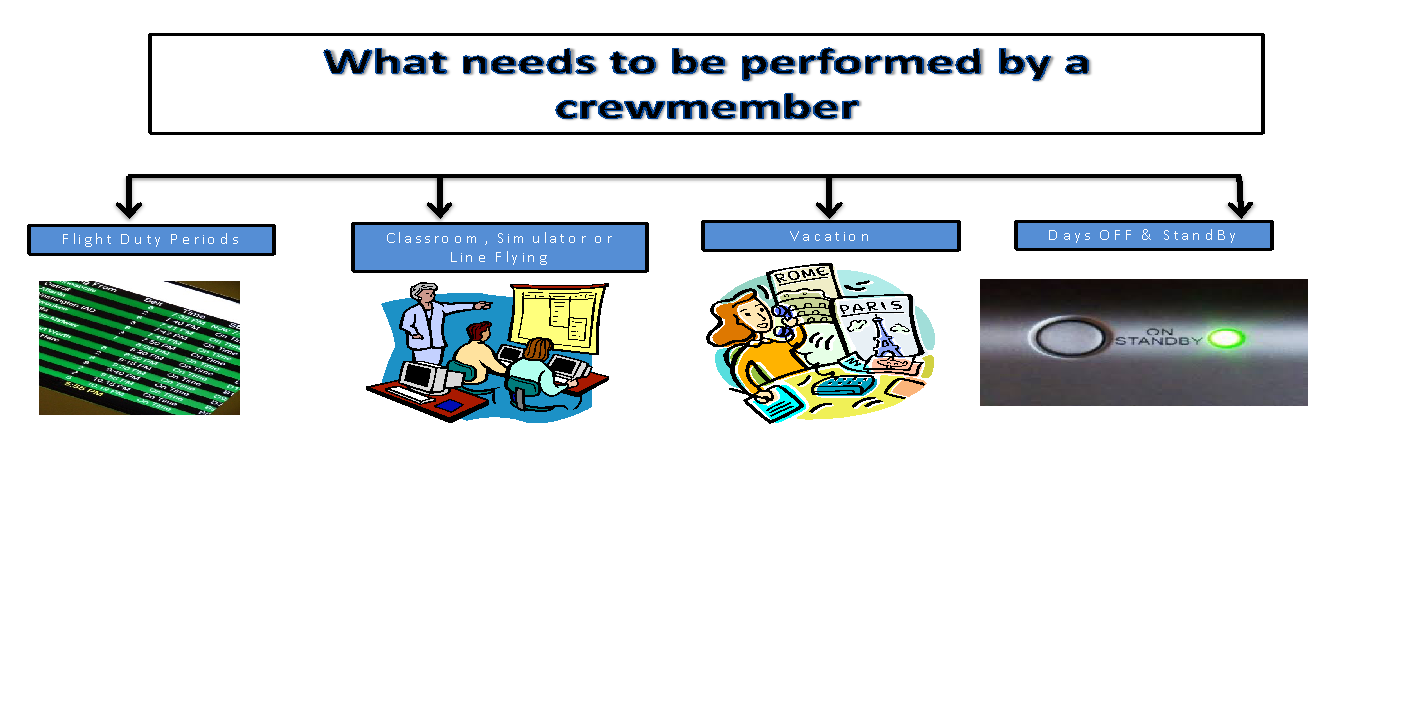
- Identify all tasks which need to be completed by crew
- Allocate those tasks and their respective skill profiles in the form of a roster
- Inform the crew of these tasks
The function of Crew Management is to allocate flying duties based on a specific set of rules and then inform the crew of these duties via a roster. This roster needs to be made available by a specified date as advised through the regulator or by company policy.
The Crew Management Processes
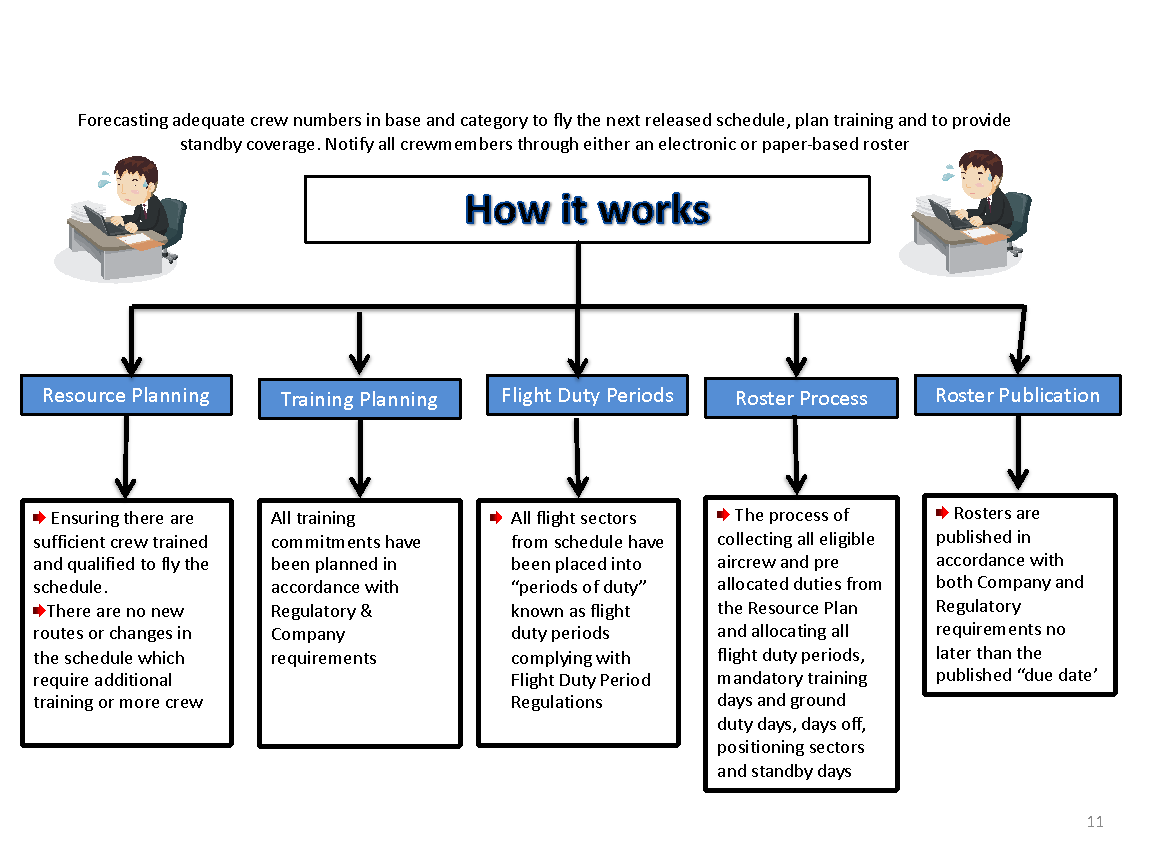
1. The Resource or Manpower Plan
Identifying the crew complement required by the organization based on the aircraft type and type of service being provided (low cost or legacy), ensuring there is enough crew trained and qualified to fly the schedule.
The assignment of annual leave to crew, usually including a leave bid ballot, is usually also a function of the Manpower planning department.
The use of a long-term crew forecasting model would ensure enough crew are already employed or in the process of being employed and trained. Where there are multiple bases and thousands of crew it is critical to know actual numbers in the manpower plan.
2. Training Planning
Ensuring all training commitments have been planned in accordance with regulatory and company requirements.
There are several reasons training is required but it will generally fall into one of the two types:
- Initial training for new crew or for crew who transfer from one position into another
- Recurrent training for crew to stay current
This is part of their defined training syllabus as per the regulator or the organization. Such training is usually conducted in three forms:
- Ground training (contact classroom or virtual classrooms or e-learnings)
- Simulator training
- Line training (on flights)
3. Creating Pairings
Ensuring all flights from the schedule have been placed into “periods of duty” typically being referred to crew pairings, patterns, or routes.
The SSIM received from Network Planning has details of all flights to be flown. The flight schedule must include aircraft type, flight times, and aircraft routings. The pairing creation process converts the aircraft schedule into periods of work for the crew. Pairings are a series of linked flights with duty and flight hour values attached. Flights are built into duty periods. A pairing may have a single duty period or multiple duty periods separated by rest periods until the crew returns to base.
At the end of the process, all the flights should be covered in pairings, unless specifically intended otherwise.
The key to building an optimal set of pairings is to minimize the number of crew who must work each day, in other words fly the crew as many hours as possible in accordance with local Flight and Duty Time Limitation Schemes defined by the airline based on the country’s regulator defined guidelines.
4. The Roster Creation
The roster creation, including publication to the crew, is the allocation of crew pairings, training, standby and rest periods into an individual crew roster, and usually published at least 10 days prior to the roster start date or as defined by the regulator of the country, company policy, or the crews’ negotiated work rules.
At the end of the process there should not be any pairings left un-crewed, unless specifically intended otherwise.
The outcome of this is published to the crew as they need to know their rostered duties, rest, and recovery periods in advance in order to plan time off and avoid the risk of fatigue.
Each activity placed onto a roster is done so based on a set of rules, known as Flight and Duty Time Limitations or FTLS or FDTL. Each activity also contains its own set of rules from the FTLS.
A crew roster planner will coordinate all aspects for the flight crew and cabin crew roster creation process whilst balancing crew satisfaction, fairness, productivity targets, budget limits, and operational robustness.
The most common forms of work allocation to crew are:
- Preferential Bidding (also known as lifestyle bidding) – crew can bid for the type of pairings they would want, day off requests, etc which gets fed as an input into the roster construction process.
- Strict Seniority Bidding – bids are awarded in a strict ordered manner, usually crew seniority. A bid of a more senior crew may not be rejected to award that of a more junior crew member.
- Bid Lines – more widely used in some legacy carriers wherein the entire line of work is pre-defined and crew can bid for the line of flying they prefer.
- Assignment – auto assignment of duties, rest, off in accordance to the FDTL
Publication of crew rosters should be completed and published in accordance with local statutory and company requirements. If rosters are published late, it may create a breach with either regulatory requirements or company policy. Once rosters are published, it becomes visible to crew and crew tracking for making changes suitably. Changes after publication require notification to crew. Also, depending on crew work rules, certain changes may not be possible anymore or come with significant costs.
5. Crew Control
After the rosters have been published, crew control will take over the maintenance thereof. They will ensure that open flying is covered, and any disruption is adequately dealt with.